
Dr. Weiss answers
your frequently asked questions
Q: Bitcoin has gone up so much since 2017 – by more than 600%. How could your portfolio have done 7.6 times better?
A: The Weiss Cryptocurrency Portfolio is designed to benefit from three powerful factors:
(1) Our cryptocurrency ratings, the only such ratings in the world, identify the most advanced crypto technologies with the highest profit potential and the lowest relative risk.
(2) Our portfolio model rotates into what our rankings determine to be the best of the best.
(3) Our strategy includes important risk-protection measures: First, each cryptocurrency’s risk level is a critical factor in our ratings. And second, we continually seek to build a cash reserve from profitable trades by taking a portion of those profits off the table.
For more details, see this article, including the important information at the bottom of that page.
Q: Some people say Bitcoin and cryptocurrencies are dead. Is that true?
A: Since it began trading, Bitcoin has plunged four times by 70% or more. And every time people have written Bitcoin’s obituary. But it keeps coming back from the dead!
If you had bought the “dead” Bitcoin after each of its first four big declines, you could have seen average gains of 6,300% or 63 to one.
Recently, Bitcoin has declined 70% again! Even if cryptocurrencies rise only half as much as in the past, you could be looking at 31-to-one gains from its lows.
Q: Why can’t I just use your weekly Weiss Cryptocurrency Ratings on my own? What’s the difference?
A: You certainly can and we think you’d do quite well. The major difference is that our weekly ratings do not give you our specific buy and sell recommendations, which we believe can provide far greater profit potential and loss protection.
To get the kind of superlative return potential we’re talking about, we do three things that are not possible with the letter grades alone.
We use the unpublished numerical score behind each letter grade to rank each cryptocurrency.
We recommend rotating funds into the ones with the top five rankings.
Then, we monitor each crypto’s Risk Index and Reward Index. That last step is important because it can help you avoid getting caught in rapid downturns or missing a major surge. Click here to review your membership benefits and enroll.
Q: Are cryptocurrencies a giant scam?
A: Cryptocurrencies are a legitimate high-tech form of money. However, like in any new, rapidly growing market, there are irregularities, including scams by some bad actors.
We rate scores of cryptocurrencies. But before we issue any grades, we gather a tremendous amount of data and look at them from every possible angle. If there’s even a hint of scam, they will not make the cut.
All cryptocurrencies meriting a Weiss Rating of C- or better pass our basic tests, and we believe this alone is a very good indication of honest players.
All those meriting a B- or better not only pass the basic tests, but are also considered robust projects that could be a great success.
Q: How can I join?
A: Just call 800-980-4102 (Overseas callers: +1-407-745-0050 ) anytime from 9am to 6pm Eastern Time. Or go here, where you can review the benefits and make your final decision.
Q: Why do you give Bitcoin such a low rating?
A: On a scale from A to F, Bitcoin gets a passing grade. So it’s not as low as it may seem. It doesn’t get a better grade because its technology is outdated, its network is clogged, its transaction fees are very high, and there’s no easy way for Bitcoin to be upgraded. Meanwhile, several second and third generation cryptocurrencies are jumping ahead, expanding rapidly in usage and delivering far greater potential profits to investors.
Q: Why did Bitcoin crash so badly early in 2018?
A: The simple answer is that, prior to the crash, it had gone up too far, too fast. Another equally important reason Bitcoin was that investors and users began to shift out of Bitcoin to more modern cryptocurrencies. That helps explain why Bitcoin’s share of the cryptocurrency market fell sharply. If you had followed our ratings, however, you could have avoided the Bitcoin crash.
Q: Why can’t I trade cryptocurrencies in my stock brokerage account?
A: Cryptocurrencies and stocks are two different things which require two types of accounts. Think of it much like gold vs. Apple. Setting up the needed accounts is not as simple as opening a brokerage account. But once you’re up and running, trading among different cryptocurrencies is not difficult.
Moreover, when you join the Weiss Cryptocurrency Portfolio, you will receive free one-on-one tech support sessions. Our Help Desk representative will answer your questions and help you navigate any websites you may need to use. To review all the benefits and decide if you wish to join, go here.
Q: What makes one cryptocurrency better than another?
A: Most cities look the same from 40,000 feet in the air. It’s only when you set foot on its streets that you can tell which is a thriving metropolis and which is a dump. The same is true for cryptocurrencies.
That’s why Weiss Cryptocurrency Ratings evaluate each cryptocurrency on thousands of data points in four main categories: Which has the most robust technology; which has the most usage and best actual performance in the real world; which has the least risk; and which gives you the most profit potential.
Most laymen (and even professionals) would have trouble understanding the fine point differences in technology and other categories, but the Weiss Cryptocurrency Ratings do that research for you. Then, all that legwork helps supports the investment recommendations sent to subscribers of the Weiss Cryptocurrency Portfolio.
Including both a year when Bitcoin rose dramatically and a year when it fell sharply and then went mostly sideways, the Weiss Cryptocurrency Portfolio could have outperformed Bitcoin 7.6 to one.*
Q: What if I’m having trouble opening an account to buy cryptocurrencies?
A: When you subscribe to the Weiss Cryptocurrency Portfolio, we will help you in three ways:
First, we will send you a beginner’s guide with simple, straightforward steps you can follow.
Second, we will give you access to short, easy-to-understand instructional videos for each step in the process.
And third, our tech support specialists will be available to help answer your questions or help you navigate the needed crypto websites.
Investors routinely pay at least $2,000 for a similar service. But you get it free with your membership.
Just remember: We are publishers, not investment advisors. So we cannot give you customized investment advice tailored to your personal needs.
For example, our specialists can show you how to execute a trade efficiently. But they cannot help you decide which trade to make or how much to invest.
Q: Are cryptocurrencies just “play money” or do they have an intrinsic value?
A: They have intrinsic value that’s supported by their current usage globally and their tremendous potential applications.
Initially, most governments ignored cryptocurrencies, thinking they were like the tokens teenagers buy in their video games. But now, major governments, including those of the U.S., Japan and the European Union, are taking cryptocurrencies far more seriously, as many officials begin to recognize they are the money of the future.
In many ways they are better than dollars, yen or euros: More private, safer, and once you get up and running, far cheaper and easier to transfer. They’re also impossible for governments to manipulate. They can’t print Bitcoin or other cryptocurrencies.
Q: How do you control risk in a high-risk cryptocurrency world?
A: It is impossible to avoid all risk. But the Weiss Cryptocurrency Portfolio seeks to control risk in three ways:
First, it is virtually impossible for the cryptocurrencies our model considers riskier to make it into our top five list.
Second, we regularly monitor our risk metrics for each cryptocurrency in our portfolio.
Third, every time we close out a profitable position, we take a third of the profits off the table, and that cash provides a cushion overall.
Thus, our back-tested results show that, when Bitcoin began to fall sharply in late December of 2017, if you could have followed our recommendations, you would have accumulated a $240,000 cash reserve.*
From that point onward, even if every cryptocurrency in the world had fallen to zero, subscribers following our advice could have still made nearly 24 times their original investment.
Q: What is a cryptocurrency wallet?
A: A cryptocurrency wallet is essentially a locked, encrypted computer file where you store your personal cryptocurrencies.
Q: What kinds of wallets are there?
A: There are basically two types of wallets:
1) There are exchange-hosted wallets on the internet that are used for trading. In some ways, these are like bank accounts in the sense that the keys to your account are held by the exchange. That’s OK for trading, but not the best solution for long-term storage.
2) There are wallets in which you and only you hold the keys. They use locked, encrypted files on your computer or an app on your smart phone. Most are free downloads. They’re available for PCs as well as from Apple and Android app stores. They’re easy to install and use.
You can also back up your wallets to hardware devices, such as thumb drives, that can be stored securely offline in a safe.
Q: You say the Weiss Cryptocurrency Portfolio could have given me 4,294% returns. That sounds too good to be true. Please explain.
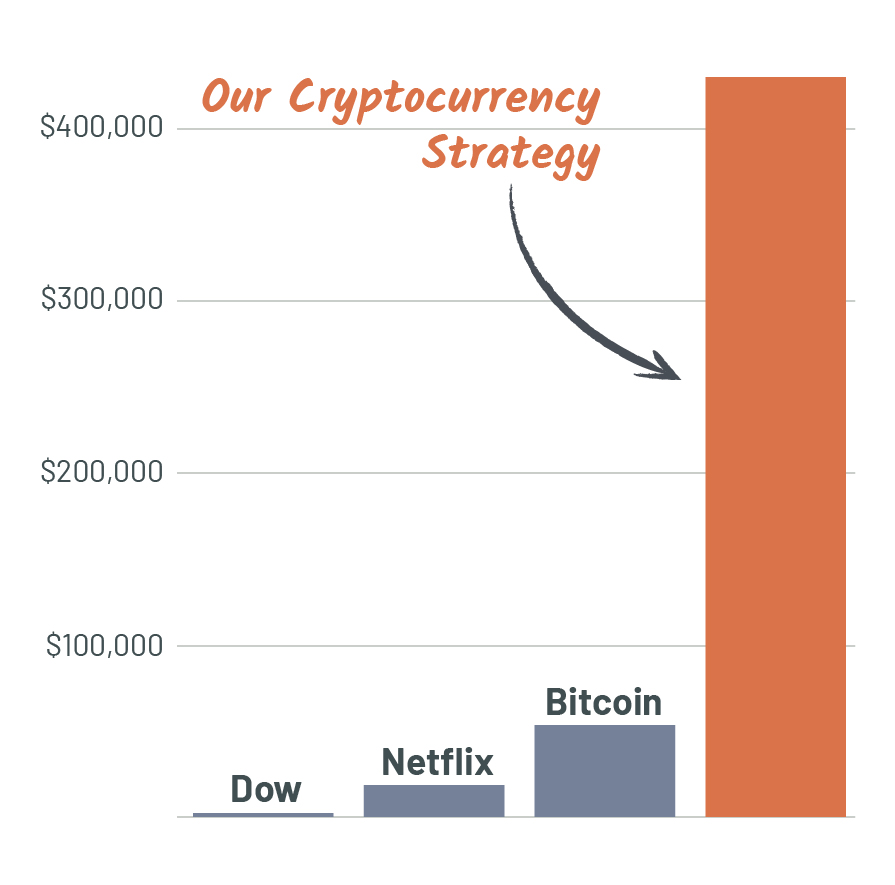
A: This calculation is based on our rigorous back-testing of our model including all of 2017, a stellar year for cryptocurrencies plus the first nine months of 2018, a bear market period.*
So it includes both some of the best and worst of times. Now, we believe a new bull market is in the making. However, you should not expect it to start with a big bang. It could take several months before we see the kind of market surge that occurred in the prior bull market. And as we’ve seen in 2018, losing years are also possible sometime in the future.
If you subscribe to Weiss Cryptocurrency Portfolio and follow the recommendations, you will own only the cryptocurrencies with the highest Weiss rankings — the ones our ratings model identifies as having the best technology, the best performance in the real world, plus the best balance of profit potential and lower risk.
To do this, invest strictly the money you can afford to lose. For example, if you just invest 5% of your investable assets in the cryptocurrencies we recommend, your overall risk is greatly reduced. Even in the extremely unlikely event that every cryptocurrency in the world falls to zero, you’d still have 95% of your money intact.
The goal: With the Weiss Cryptocurrency Portfolio, that small 5% of your portfolio could give you far greater gains than the 95% you hold in traditional investments.
Click here to review your privileges as a member of Weiss Cryptocurrency Portfolio.
Q: Will major governments regulate cryptocurrencies?
A: We’d love to see that happen. When we review which cryptocurrencies to rate, we sometimes find a few that are suspicious looking. It is impossible for them to get a passing grade. So they should never affect you directly.
But they give the cryptocurrency industry a bad name and can increase the volatility of the market. So if major governments begin regulating cryptocurrencies, it should be a good thing. Hopefully, they would eliminate most of scam artists and frauds, much like the SEC and CFTC did in the early days of the securities and commodities markets. That would be a positive development for the legitimate cryptocurrency market.
Q: Will the U.S. government tax cryptocurrency profits?
A: It already does. American residents and citizens must pay taxes on cryptocurrency profits. Consult with your tax specialist on how to report them.
Q: I read a lot about cryptocurrencies in chat groups and in social media. It’s so confusing. Whom should I believe?
A. You have good reason to be wary.
Many on the Internet sing the praises of one crypto while bashing another. Unfortunately, those who speak the loudest often have a financial interest in a particular coin and seek to influence the market for their own personal gain. By contrast, our Weiss Cryptocurrency Ratings are 100% objective and free of any conflicts of interest.
Q: We’re planning for retirement and it seems the only solutions we’re offered are either ridiculously low yield or ridiculously high risk. Which do you choose?
A. Neither, of course! Both are obviously non-starters.
The first so-called “solution” is just to plop your money into bank CDs or equivalent. But what good does that do you? Even if you have a nest egg of, say, $500,000, and even if you could find a bank that gives you 2% interest, all you wind up with is $10,000 per year. How do you pay the mortgage and buy food with only $10,000?
The second solution is even worse. You put all or most of your money in a high-risk speculation of some kind and then, suddenly, your principal is gutted.
The solution we offer with the Weiss Cryptocurrency Portfolio is based on three important principals:
- Speculation is not recommended for your retirement nest egg, but it is OK for the money you can afford to lose.
- For speculation to be worthwhile, you need a strategy to reduce risk and go for life-changing gains.
- That strategy must be based on in-depth analysis of reliable data that’s 100% objective and completely free of any conflicts of interest.
Weiss Ratings does not accept any form of compensation from creators, issuers or sponsors of cryptocurrencies. Nor are the Weiss Cryptocurrency Ratings intended to endorse or promote an investment in any specific cryptocurrency. Cryptocurrencies carry a high degree of risk. The SEC, CFTC and other regulators have expressed concerns with the volatility of the market and the actions of sponsors of specific cryptocurrencies. So be sure to review their official consumer alerts such as the public statement on cryptocurrencies by the SEC.
* The $439,367 result is based on backtesting with historical data that makes several assumptions, including the following: (1) A starting investment of $10,000 on January 2, 2017. (2) Weekly rotation among the five cryptocurrencies with the highest rankings as determined by the Weiss Cryptocurrency Ratings model. (3) After each profitable trade, taking one-third of that trade’s proceeds off the table and placing it in a cash reserve, not to be reinvested. (4) Continuing this strategy until September 29, 2018.
Other variations of our trading model were also tested, varying the number of cryptocurrencies in the portfolio and the frequency of each review. When the strategy was tested with just four, three or two top-ranked cryptocurrencies in the portfolio, the results were significantly better. When it was tested rotating the portfolio daily instead of weekly, the results were vastly better. We made every effort not to use 20-20 hindsight to create the Weiss Cryptocurrency Ratings. And we did not choose the trading model with the highest return. Rather, we selected the trading approach that’s the easiest to follow, while providing the best balance of profit potential and reduced risk.
The test period includes the unusual rise in the cryptocurrency market from January through mid-December of 2017 as well as the unusual decline in the market from mid-December 2017 through early February, 2018. Plus, it also includes further declines in many altcoins through September 29, 2018. These ups and downs may not be typical. Investors should also recognize that backtesting based on historic data has several limitations. For example, it does not include transaction fees. It does not account for the fact that investors don’t always get the prices they expect. It is not possible to completely eliminate the benefit of hindsight. However, our backtesting was designed to be rigorous and fair. We feel it provides a good indication of the potential to greatly outperform Bitcoin in both up and down markets.
Even so, it is not our intention to follow the model blindly. We will make needed adjustments to adapt to market conditions. For example, when Weiss Cryptocurrency Portfolio was first launched on March 1, 2018, we anticipated declines in Bitcoin and other cryptocurrencies followed by a period of stagnation. Therefore, we made the decision to avoid active trading until market conditions improved, helping to limit losses.
Weiss Cryptocurrency Portfolio recommends strictly Distributed Ledger Technology (DLT) protocols. This is the technical term to describe cryptocurrencies like Bitcoin, Ethereum, Cardano, EOS, NEO, Holochain and others, whether before or after their "Mainnet" launch. However, we do not recommend any of the thousands of utility tokens, which are a fund-raising vehicle typically used by start-up companies and often referred to as "ICOs."
Weiss Ratings does not accept any form of compensation from creators, issuers or sponsors of cryptocurrencies. Nor are the Weiss Cryptocurrency Ratings intended to endorse or promote any specific cryptocurrency. We stand ready to give you the tech support you may need to open cryptocurrency accounts and navigate the needed websites, but we do not provide customized advice that’s tailored to your individual circumstances.
Cryptocurrencies carry a high degree of risk. The SEC, CFTC and other regulators have expressed concerns with the volatility of the market and the actions of sponsors of specific cryptocurrencies. So be sure to review their official consumer alerts, especially the SEC’s “Statement on Cryptocurrencies and Initial Coin Offerings” as well as the CFTC’s “Customer Advisory: Beware Virtual Currency Pump-and-Dump Schemes.”
For a complete review of our Terms and Conditions, click here.